RFID Inventory Management: How a 100-Hour Stock Audit Becomes a 45-Minute Sweep
How UHF RFID replaces manual counting, what read rate and read range really mean on a shop floor, and why materials decide whether a pilot works.
Cifr Team · · 7 min read
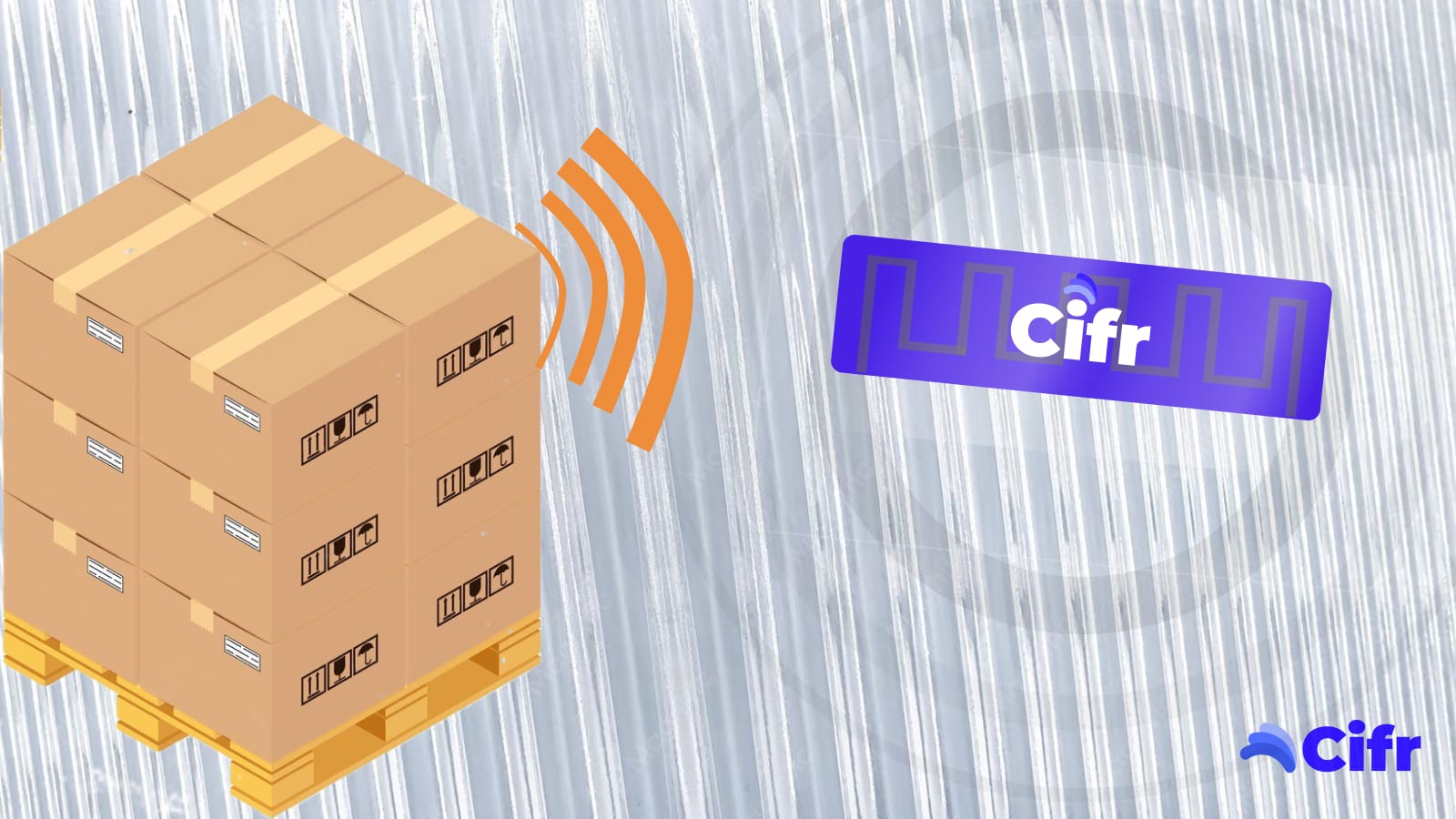
Most inventory systems do not have a counting problem. They have a currency problem. The stock figure is accurate on the day of the count and decays every day after it, because every sale, return, transfer and shrinkage event introduces a small error that nothing corrects until the next manual count.
Manual counting is what makes counts rare. UHF RFID changes the economics: reading does not require line of sight, so items are counted in bulk rather than one at a time. On Cifr deployments that turns a 100-hour manual stock audit into a 45-minute autonomous sweep, with read rates above 1,300 tags per second at up to 33 metres and sub-metre item finding.
- Barcode: one item, one scan, line of sight required, human-paced.
- UHF RFID: hundreds of items per second, through cartons and clothing, no line of sight.
- The operational effect: counts move from annual or quarterly to weekly or daily.
- The commercial effect: accuracy stops decaying, so safety stock and markdowns fall.
[Visual · Comparison] A tall stack of folded garments read in a single pass versus the same stack counted by hand.
Why inventory accuracy decays
A typical retail or warehouse operation counts fully once or twice a year and cycle-counts a fraction in between. Between counts, accuracy erodes from predictable sources: mis-scanned receipts, unrecorded transfers between locations, returns put back in the wrong place, theft, and simple mis-picks.
The cost is rarely booked as an inventory problem. It shows up as:
- Phantom stock — the system says you have it, so you do not reorder, and you lose the sale.
- Safety stock — you hold extra units to insure against a figure you do not trust.
- Markdowns — stock found too late is sold at a discount.
- Wasted labour — staff spend hours looking for items the system believes are on hand.
None of these is solved by counting more carefully. They are solved by counting more often, which is only affordable if counting is fast.
What read rate and read range actually mean
Vendor specifications are easy to misread, so it is worth being precise about what the numbers do and do not promise.
Read rate
A figure like 1,300 tags per second describes how quickly a reader can resolve tags that are already responding. It is a throughput ceiling, not a guarantee that every tag in a room will be read in that time. Real-world sweep speed depends on tag density, orientation and the material each tag is mounted on.
Read range
A 33-metre range is achieved with a favourable tag, a clear path and a fixed reader at full power. The same tag at the back of a metal shelving unit will read at a fraction of that. Range is a property of the whole system — reader power, antenna gain, tag design and environment — not of the tag alone.
Why materials dominate everything
The two materials that defeat naive UHF deployments are metal, which reflects and detunes, and liquid, which absorbs. A tag flat on a steel shelf or on a bottle of shampoo may not read at all.
This is solved mechanically rather than with more power. An anti-metal tag uses a dielectric spacer to lift the antenna off the conductive surface, which restores the tuning. Cifr’s TensorTag uses a copper meander dipole antenna designed for this, and the anti-metal variant is specified for steel-mounted assets.
The practical consequence: a pilot that works in a clean test area and fails on the shop floor is almost always a materials and mounting problem, not a reader problem.
[Visual · Diagram] An anti-metal tag on a steel plate, lifted by a dielectric spacer and still reading.
Fixed readers, handhelds, and what each is for
The two form factors solve different problems and most mature deployments use both.
Fixed readers are mounted at choke points — doorways, dock doors, stockroom thresholds — and record movement automatically. A rugged four-port UHF reader covers a wide portal with multiple antennas. Their value is that they require no labour at all: the count updates because stock moved, not because someone counted it.
Handheld readers are used for sweeps and for finding. A pistol-grip reader with a rear antenna module lets an operator walk a floor and resolve everything in range, then switch to directional finding to locate one specific item to within a metre.
Together these give you two different things: fixed readers maintain continuous accuracy at boundaries, handhelds deliver periodic certainty across the whole estate.
RFID vs barcode vs manual counting
| Manual count | Barcode scanning | UHF RFID | |
|---|---|---|---|
| Line of sight needed | Yes | Yes | No |
| Items per second | ~0.2 | ~1 | 1,300+ |
| Reads through cartons | No | No | Yes |
| Full-estate audit effort | ~100 hours | Tens of hours | ~45 minutes |
| Locates a specific item | By searching | By searching | Sub-metre directional |
| Realistic count frequency | Annually | Quarterly | Daily or weekly |
| Per-item consumable cost | None | Negligible | Low, per tag |
| Works on metal and liquids | Yes | Yes | Only with engineered tags |
Where authentication and inventory meet
Most RFID inventory tags are readable but not trustworthy: the tag’s UID can be read by anyone and written into a copy. For pure stock counting that is usually acceptable — there is little incentive to forge a tag on your own stock.
It stops being acceptable at three points: returns, where a counterfeit item can be returned against a genuine SKU; grey-market diversion, where you want to know whether a unit surfacing elsewhere is genuinely yours; and high-value goods, where the tag is also the authenticity claim.
This is why Cifr Duo puts a UHF antenna and an NFC coil in one label under a unified identity. The warehouse reads the item in bulk at range for counting; a customer or inspector taps the same item with a phone and gets a cryptographic proof of authenticity. One tag, one identity, two very different jobs.
Frequently asked questions
Do I need to tag every item, or just cartons? Carton-level tagging is cheaper and solves logistics visibility. Item-level tagging is what delivers shelf accuracy and item finding. Most retailers who start at carton level move to item level.
Will RFID work in my store with metal fixtures? Usually yes, but only with the right tag and mounting. Specify a site survey rather than assuming a generic inlay will perform.
What accuracy should I expect? Well-executed item-level deployments commonly report inventory accuracy moving from the 60–80% range into the high 90s. The gain comes from count frequency, not from any single count being more precise.
Does RFID replace barcodes? Not immediately. Most operations run both during transition, with the barcode as the fallback and the human-readable reference.
Can the same tag do authentication? Only if it carries a secure element. A standard UHF tag’s identifier is readable and therefore copyable.
Find out what your stock figure is actually worth
If your team counts once a year and plans against that figure for twelve months, the gap between the number and the shelf is where your margin is going.
Talk to our team about a site survey and tag selection, or see the full inventory management platform.
Filed under
- inventory management
- RFID
- retail operations
- stock audit
- supply chain
- warehouse
- cycle counting