How to Stop Counterfeit Watches When Every Security Feature Gets Copied
Security features lose because they are copyable by definition. Why brands keep losing the arms race, and what changes when proof replaces appearance.
Cifr Team · · 7 min read
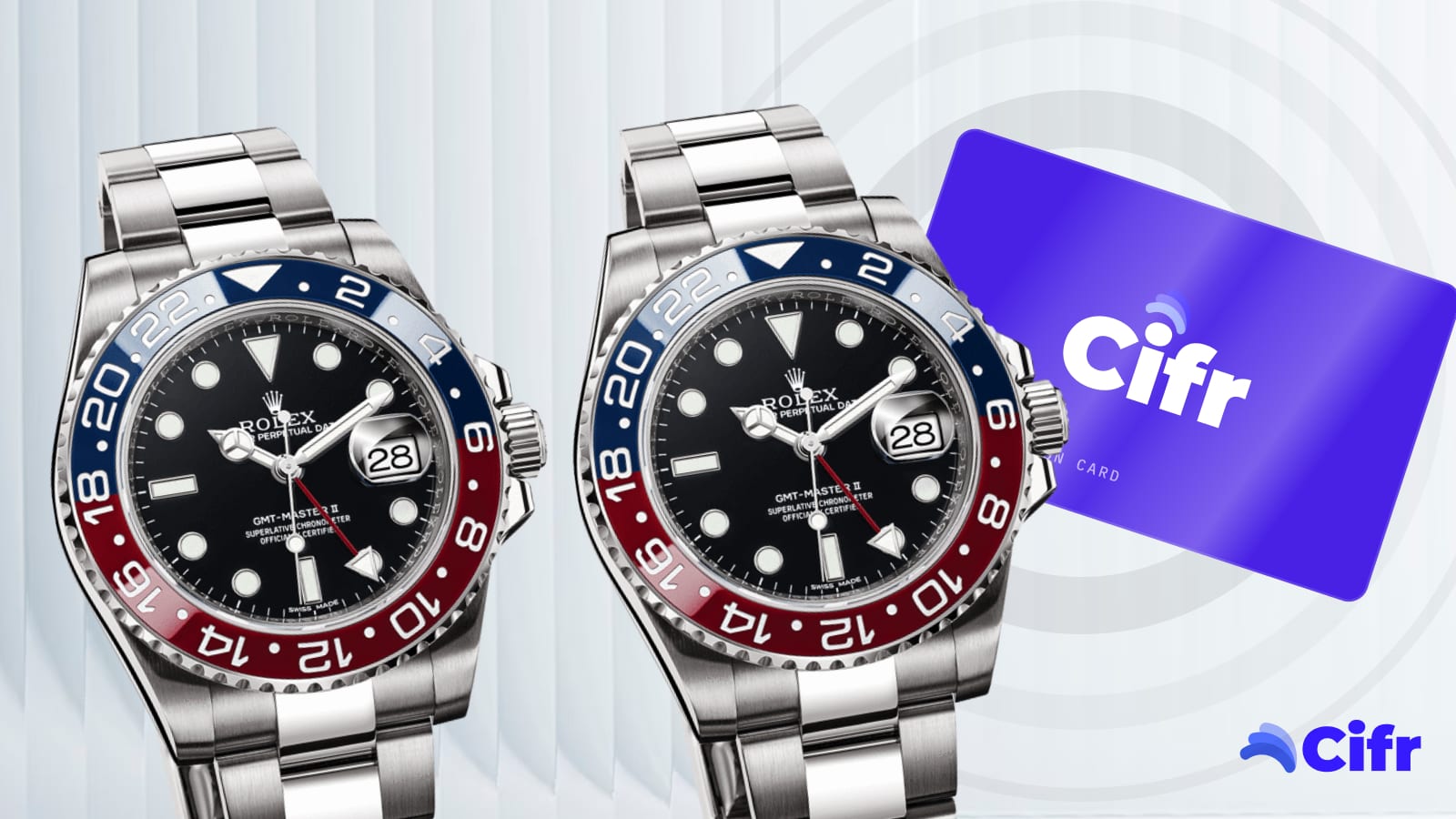
Every physical security feature a brand has ever deployed shares one property: it must be visible to be checked, which means it can be observed, and anything observable can eventually be reproduced. Guilloché dials, laser-etched crystals, microtext, holograms, serialised cards and QR warranty codes all failed the same way, in the same order, for the same reason.
The pattern is consistent enough to predict:
- A feature is introduced and genuinely works for a period.
- The feature is publicised so buyers know to look for it.
- Publication becomes a specification — counterfeiters now know exactly what to replicate.
- The feature is reproduced, and the brand adds another one.
Each cycle costs tooling, supply-chain change and marketing. Each ends in the same place, because the underlying model — prove authenticity by appearance — is the thing that fails, not the particular feature.
The economics are against the brand
This is not a story about counterfeiters being clever. It is a story about asymmetric incentives.
A brand amortises a security feature across its production and must justify the unit cost against margin. A counterfeiter amortises the cost of defeating that feature across every fake they will ever make, and the investment is recovered on the first production run. As a reference becomes more liquid, the counterfeiter’s budget grows while the brand’s per-unit security budget stays flat.
Worse, the brand must publicise the feature for it to function. A security marker nobody knows to check protects nothing. So the brand is obliged to hand the specification to the people defeating it. There is no version of this game where the defender wins permanently.
What that has cost, commercially
Brand-protection budgets usually get justified on seized goods and takedowns. The larger costs sit elsewhere and rarely appear in the same report.
Secondary-market erosion. When buyers cannot verify, they discount. A pre-owned piece whose provenance cannot be independently confirmed trades below one that can — a spread commonly cited in the region of 15–30% depending on reference and paperwork. That discount is value removed from your brand’s market, and it depresses the aspirational pricing of new stock.
Service-network load. Workshops absorb the cost of identifying fakes and hybrids presented for service, piece by piece, as skilled manual work.
Client relationships that end at the till. Most of a watch’s life, and most of its transactions, occur after the first sale. A brand that cannot identify the second or third owner has no relationship with the majority of the people wearing its products.
Legal spend that scales with the problem. Enforcement is a recurring cost that grows with your success and never converts into an asset.
[Visual · Diagram] The feature arms race — introduce, publicise, replicate, repeat — against a verification model that does not depend on appearance.
The architectural change: stop describing, start proving
The alternative is not a better feature. It is a different question.
Every appearance-based marker asks: does this object look the way a genuine one should? A counterfeiter answers that with manufacturing quality, and manufacturing quality is purchasable.
A secure element asks instead: can this object prove it holds a secret?
The chip is fitted to the timepiece and to its authentication card. It generates an asymmetric key pair on-chip at manufacture. The public key is registered and can be published freely. The private key is non-exportable — there is no command, interface or firmware path that reads it out, so it never appears in a database, never crosses a network and never exists in a copyable form.
Verification is a live cryptographic exchange rather than a lookup:
- The verifying phone issues a random challenge — fresh and unpredictable for that tap alone.
- The chip signs that challenge with its private key.
- The signature is checked against the registered public key.
Because the challenge differs every time, so does the response. A recorded scan is valid only for the challenge it answered, so replay fails. And a clone that copies every readable byte off the chip copies the public identifier but not the key, so it cannot sign a new challenge and is rejected on the first tap.
As the luxury watch platform puts it: a replica can copy the case to the milligram. It cannot produce the private key.
Why this one does not degrade
The critical property is that publicising it costs nothing. You can publish the entire protocol, the public keys and the verification method. None of it helps a counterfeiter, because the security rests on a secret that was never published and cannot be extracted.
That breaks the cycle at the step where every previous feature failed. There is no specification to hand over.
What this replaces
| Physical security features | Serialised cards and QR | Secure-element verification | |
|---|---|---|---|
| Degrades when publicised | Yes — publication is a spec | Yes | No |
| Defeated by manufacturing budget | Yes | Not applicable | No |
| Requires buyer expertise | Yes | No | No |
| Verifiable by a client’s own phone | No | Yes | Yes |
| Detects a hybrid or swapped calibre | Rarely | No | Yes, against manufacture record |
| Costs recur each product cycle | Yes | Low | One integration |
| Produces a client relationship | No | Minimal | Yes, through every resale |
| Works outside your retail network | No | Partly | Yes |
What integration actually involves
For a manufacture, the practical questions are narrower than the strategy suggests.
At the atelier. The chip is provisioned during assembly and bound to the piece and its card. The Manufacture Genesis Record is signed at that point — the origin is established where it is true, rather than asserted later on paper.
Against the movement. The Caliber Blueprint records the exact movement specification for that piece, matched to the manufacture record, which is what exposes a swapped or cloned calibre rather than merely a fake case.
Through the service network. Workshops check a piece in by tapping it, and the Certified Service History updates itself — each master watchmaker sign-off, pressure check and replaced part recorded in order.
Into the secondary market. Ownership transfers are signed by the chip, so provenance survives every resale and the next owner is identifiable rather than anonymous.
Frequently asked questions
Does this replace our existing security features? It does not require removing them. It removes the need to keep adding new ones, because it is the first layer that does not decay when it becomes known.
Can the chip be removed and fitted to a counterfeit? The binding between chip, piece and card is tamper-evident; breaking it is detectable and a piece with a broken binding is itself a clear signal.
What happens to pieces already in the field? Existing stock is unaffected. Provisioning applies from a production run forward, which is why the decision usually sits alongside a reference or packaging change.
Does a client need an app? No. Verification runs over the NFC radio already present in modern smartphones.
Is this only viable for high complications? The economics are clearest at high value, but low-cost chip families have moved the threshold well down the range.
Stop funding an arms race you cannot win
Every feature cycle buys time. None of them buys an end state.
Schedule an enterprise demo to walk through chip provisioning on your manufacture line, or read the full luxury watch authentication guide for the underlying mechanics.
Filed under
- brand protection
- anti-counterfeiting
- luxury watches
- manufacturing
- secure element
- enterprise