Your Watches Trade for Decades. Your Client Relationship Ends at the Till
Most of a timepiece's transactions happen after the first sale, invisible to the brand. What that costs, and how a connected piece closes the gap.
Cifr Team · · 7 min read
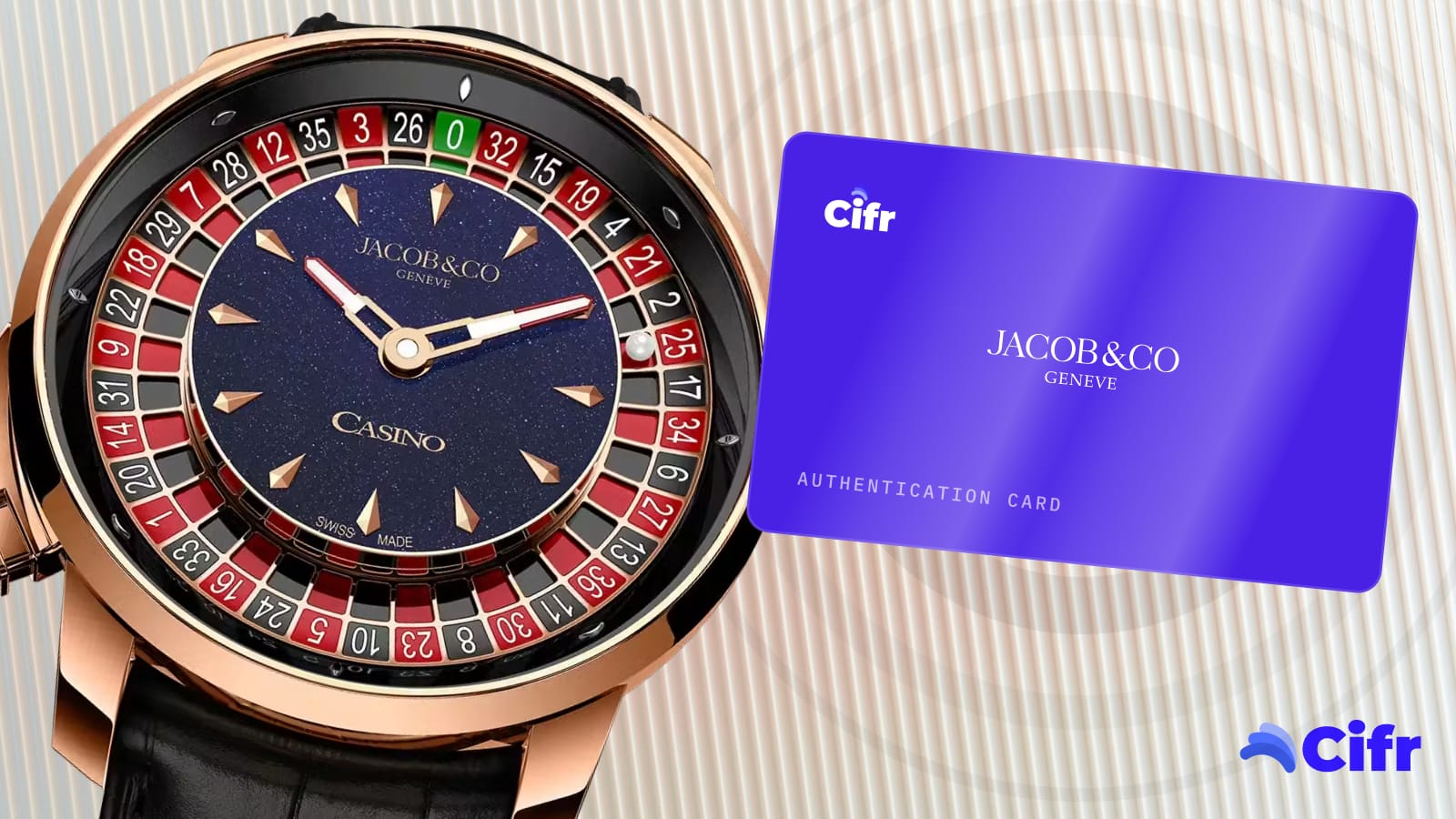
A luxury timepiece will typically change hands several times over its life. A brand usually sees exactly one of those transactions. Everything after the boutique sale — the resale, the second owner, the third, the servicing performed elsewhere, the auction twenty years later — happens in a market the brand helped create and cannot observe.
The commercial consequences compound:
- The majority of owners are anonymous. You have a client record for the first buyer and nothing after.
- The majority of transactions are invisible. Secondary volume routinely exceeds primary volume by a wide margin on liquid references.
- Secondary pricing shapes primary pricing — and you have no instrument to influence it.
- Every resale is a client acquisition you paid for and someone else collected.
The data gap, stated plainly
Consider a steel sports reference sold in 2016. The original client is in your CRM. Over the following decade the piece sells privately, is serviced by an independent watchmaker, sells again through a secondary platform, and is now worn daily by someone who has never interacted with your brand.
That person owns your product, wears it as identity, discusses it in collector communities, and is a strong candidate for a future purchase. To you they do not exist.
Multiply across a production run and the scale becomes clear: your largest owner cohort is the one you cannot contact. Marketing spend goes to acquiring new clients while existing owners — already converted, already loyal to the object — are unreachable.
Why the usual fixes do not close it
Warranty registration captures the first owner only, and only if they bother.
Service visits reach a fraction of owners and only those who use your network. Independent servicing is invisible by design.
Owner clubs and registries are opt-in, so they self-select for the engaged and miss everyone else.
Secondary platform partnerships give you aggregate market data, not an identified relationship with the person wearing the watch.
Each of these is a survey. None of them is a connection to the object.
[Visual · Lifecycle] One piece, four owners, twenty years — and the single point at which the brand currently has visibility.
The doubt discount is your money
There is a second cost, and it is larger than most brand teams model.
When a buyer cannot independently verify a pre-owned piece, they price the uncertainty. A timepiece whose provenance rests on separable paperwork trades below a comparable verified one — commonly cited in the region of 15–30% of fair value depending on reference and how much documentation survives.
That discount is not a secondary-market problem that stays in the secondary market. Resale values anchor primary desirability. A reference that holds value supports its own retail price and the aspirational positioning of everything above it. A reference that trades at a doubt discount drags on both.
So the brand pays twice: once in lost client relationships, and again in depressed residual values that feed back into primary pricing power.
What changes when the piece carries its own identity
A secure element fitted to the watch and its authentication card gives the object a verifiable identity that persists independently of paperwork or ownership. The private key is generated on-chip and cannot be exported, so the identity cannot be cloned onto another piece or separated from this one.
Three things follow directly.
Ownership transfers become events you can see
Each transfer is signed by the chip rather than asserted on a receipt. When a piece changes hands, the passport records it. The second owner is not an anonymous market participant — they are a registered holder of your product, and the relationship transfers with the watch.
As the platform frames it: the piece stays connected through resale, so the second owner is still your client.
The doubt discount disappears on verified pieces
Any buyer verifies authenticity, manufacture origin, calibre specification and full service history in one tap, in seconds, without an appraisal. There is nothing left to discount for. The value that was being conceded to uncertainty stays in the asset — and therefore in your brand’s residual pricing.
Ownership becomes a channel rather than a record
Because the physical piece is the credential, you can address owners through the object itself:
- Tap-gated allocations — priority on new references for verified owners, with the watch as proof of standing.
- VIP concierge and private viewings, unlocked by the piece rather than by an email list.
- Manufacture event access — atelier visits, launches and owner-only dinners.
- Service prompts that reach the current owner, not the person who bought it in 2016.
This is the part most brand teams underestimate. Authentication is the entry condition; the asset is a permanent, verified, direct line to everyone who owns your product.
What each approach actually delivers
| Warranty registration | Owner club | Platform partnership | Chip-bound passport | |
|---|---|---|---|---|
| Captures first owner | Yes, if they register | Opt-in | No | Yes |
| Captures second and later owners | No | Rarely | Aggregate only | Yes, each transfer |
| Survives independent servicing | No | No | No | Yes |
| Identifies the current owner | No | Stale | No | Yes |
| Works outside your retail network | No | Partly | Partly | Yes |
| Reduces the doubt discount | No | No | Slightly | Yes |
| Can gate allocations and access | No | Crudely | No | Yes, by the piece |
| Requires owner effort to maintain | Yes | Yes | n/a | No — a tap |
How this is usually phased
Start with one reference or collection. Provision at the atelier on a new production run, so the Genesis Record is signed where it is true.
Connect the service network next. Workshops tap a piece to check it in and the ledger updates itself, which gives you current-owner visibility without asking anyone to fill in a form.
Then open the owner channel. Allocations, viewings and events gated by the piece — which is also what drives owners to register transfers, because the benefit is concrete.
Finally, work with the secondary trade. Dealers and auction houses verifying at intake generate the signals that make the whole picture current.
Frequently asked questions
Is this a loyalty programme? No. A loyalty programme asks people to enrol. This binds identity to the object, so it works for owners who never opt into anything.
What about owner privacy? Transfers are signed by the chip and the owner controls their registration. The passport proves the chain of custody; it does not require an owner to expose themselves to you if they decline.
Do we need to control the secondary market for this to work? No, and that is the point. It works precisely because it functions in markets you do not control.
How does this interact with our CRM? Verified ownership events are the input your CRM currently lacks — a current-owner signal rather than a point-of-sale snapshot.
What if a piece is sold privately with no dealer involved? The transfer is signed between the parties through the passport. No intermediary is required.
Own the relationship for the life of the piece
Your products outlive your client records by decades. They do not have to.
Schedule an enterprise demo to see how ownership transfer, allocations and service check-in work together, or read the luxury watch authentication guide.
Filed under
- secondary market
- brand strategy
- luxury watches
- customer data
- resale
- enterprise